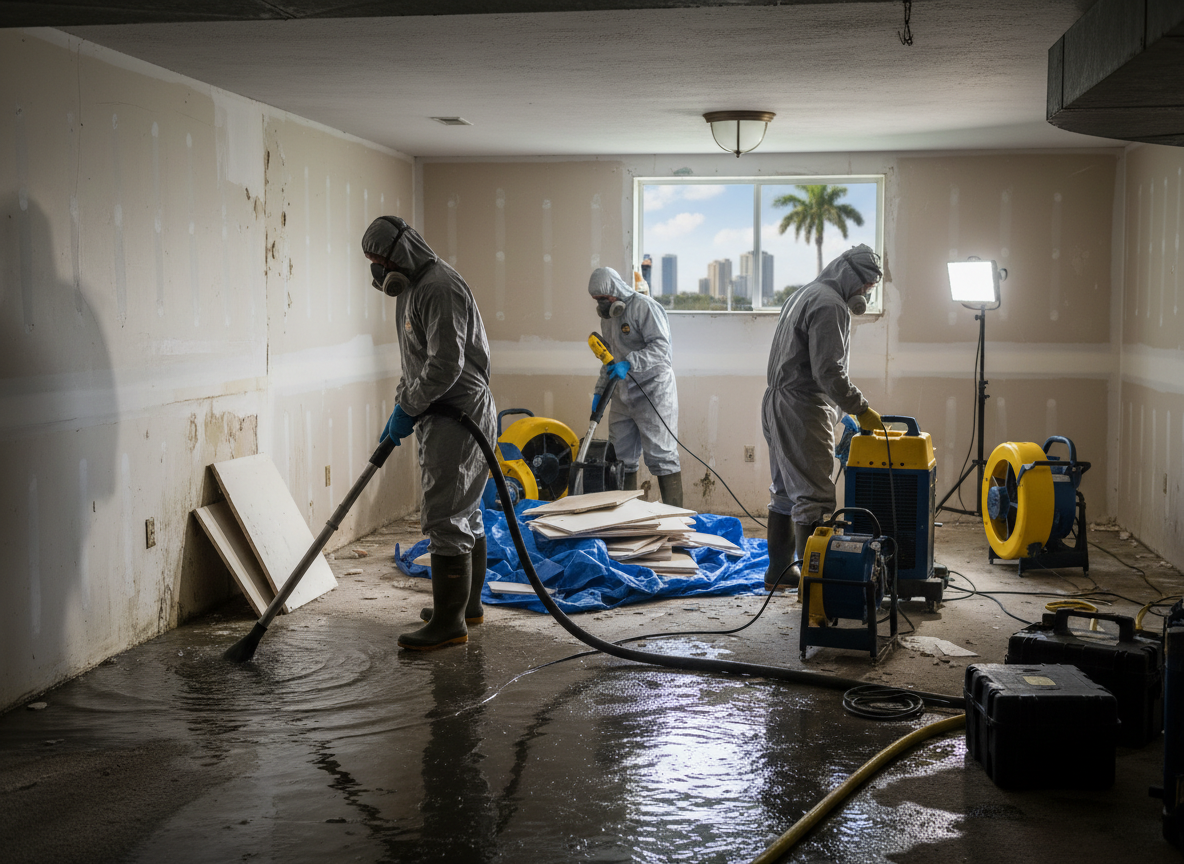
St. Petersburg homes built before 1960 often feature plaster-over-lath walls and slab-on-grade foundations that trap moisture after even modest leaks. When a supply line bursts or a roof fails during a summer thunderstorm, water migrates laterally under tile or hardwood and into the stucco exterior, creating hidden saturation zones that standard fans miss. Technicians must pull baseboards, drill weep holes, and use moisture meters calibrated for Florida humidity to map the full extent before any drying begins.
Pinellas County’s high water table and poor drainage in low-lying blocks near Coffee Pot Bayou or the Grand Central District turn routine appliance overflows into multi-room events within hours. Salt-laden air accelerates corrosion on metal HVAC components and electrical boxes once drywall stays wet longer than 48 hours. Restoration crews therefore stage industrial dehumidifiers sized for 80-plus-percent relative humidity and run them in tandem with air movers directed at both the slab and wall cavities to reach acceptable moisture readings.
After extraction, affected materials must be evaluated against current Florida Building Code requirements for flood-damaged structures. In many 1920s–1950s St. Petersburg bungalows, saturated insulation behind exterior sheathing cannot be salvaged and must be removed to prevent mold that thrives in the area’s year-round warmth. Final clearance testing includes both visual inspection and pinless meter checks on every wall plane before any reconstruction starts.
Homeowners in neighborhoods such as Old Northeast or Euclid-St. Paul often discover that carpet pad and subfloor plywood delaminate quickly once water sits for more than a day. Crews remove and dispose of these layers on-site, then treat the concrete slab with antimicrobial solutions formulated for high-humidity environments before installing new underlayment. This sequence prevents recurring odor issues common after Gulf Coast storms.
Technician insight
In St. Petersburg the thing that catches most people out with Emergency Water Damage Restoration is how quickly moisture travels laterally under 1940s–1950s slab homes once the high water table rises after a heavy rain; homeowners often stop at visible puddles while the plaster walls and subfloor stay saturated for days.
Old Northeast Bungalow After Summer Storm
A 1952 wood-frame home near Coffee Pot Bayou took several inches of rainwater through a roof valley during a July thunderstorm. We found water had wicked under the oak flooring and into the exterior plaster on two walls. After extraction and targeted drying we removed the compromised subfloor sections, treated the slab, and restored the finishes so the owners could move back in without odor or mold issues.
Emergency Water Damage Restoration Services We Offer
✓Emergency Water Extraction
Rapid removal of standing water from floors and cavities using truck-mounted pumps sized for St. Petersburg slab homes.
✓Structural Drying and Dehumidification
Industrial drying of walls, ceilings, and subfloors with moisture mapping tailored to older plaster and stucco construction.
✓Burst Pipe Restoration
Isolation of leaks, selective demolition, and full drying of affected rooms in homes throughout downtown and Kenwood.
✓Storm and Flood Cleanup
Extraction and antimicrobial treatment after heavy rains or tropical systems that overwhelm local drainage in low-lying blocks.
✓Sewage and Contaminated Water Remediation
Safe removal and sanitation of Category 3 water intrusions common after main-line backups in older Pinellas County plumbing.
✓Content Drying and Pack-Out
Inventory, removal, and climate-controlled drying of furniture and belongings to prevent secondary damage in humid conditions.
Emergency Water Damage Restoration Cost in St. Petersburg, FL
| Service | Typical Range | What Affects It |
|---|---|---|
| Initial Assessment And Moisture Mapping | Free | During listed business hours; after-hours dispatch fee may apply |
| Emergency Water Extraction | $600–$1,800 | Varies by volume and access to slab or crawlspace |
| Full Structural Drying Package | $900–$2,400 | Includes equipment, daily checks, and final readings |
| Category 3 Sewage Cleanup Add-On | $1,200–$3,000 | Covers containment, removal, and sanitation protocols |
| Content Pack-Out And Drying | $400–$1,200 | Depends on volume and whether climate-controlled storage is needed |
Ranges are typical for St. Petersburg, FL and confirmed with an exact written quote before any work starts.
How it works
- 1
On-Site Assessment
Technician arrives, documents moisture levels with meters, and identifies affected materials in St. Petersburg construction types.
- 2
Water Removal
Standing water is extracted using pumps and wands, followed by immediate containment to protect unaffected rooms.
- 3
Drying And Monitoring
Equipment is placed and daily moisture readings are recorded until all cavities reach dry standards for the local climate.
- 4
Restoration And Repairs
Damaged drywall, flooring, and insulation are replaced and finishes matched to the home’s original character.
Pricing
Upfront written estimates after inspection; final cost depends on square footage affected, depth of saturation, and whether contents require pack-out.