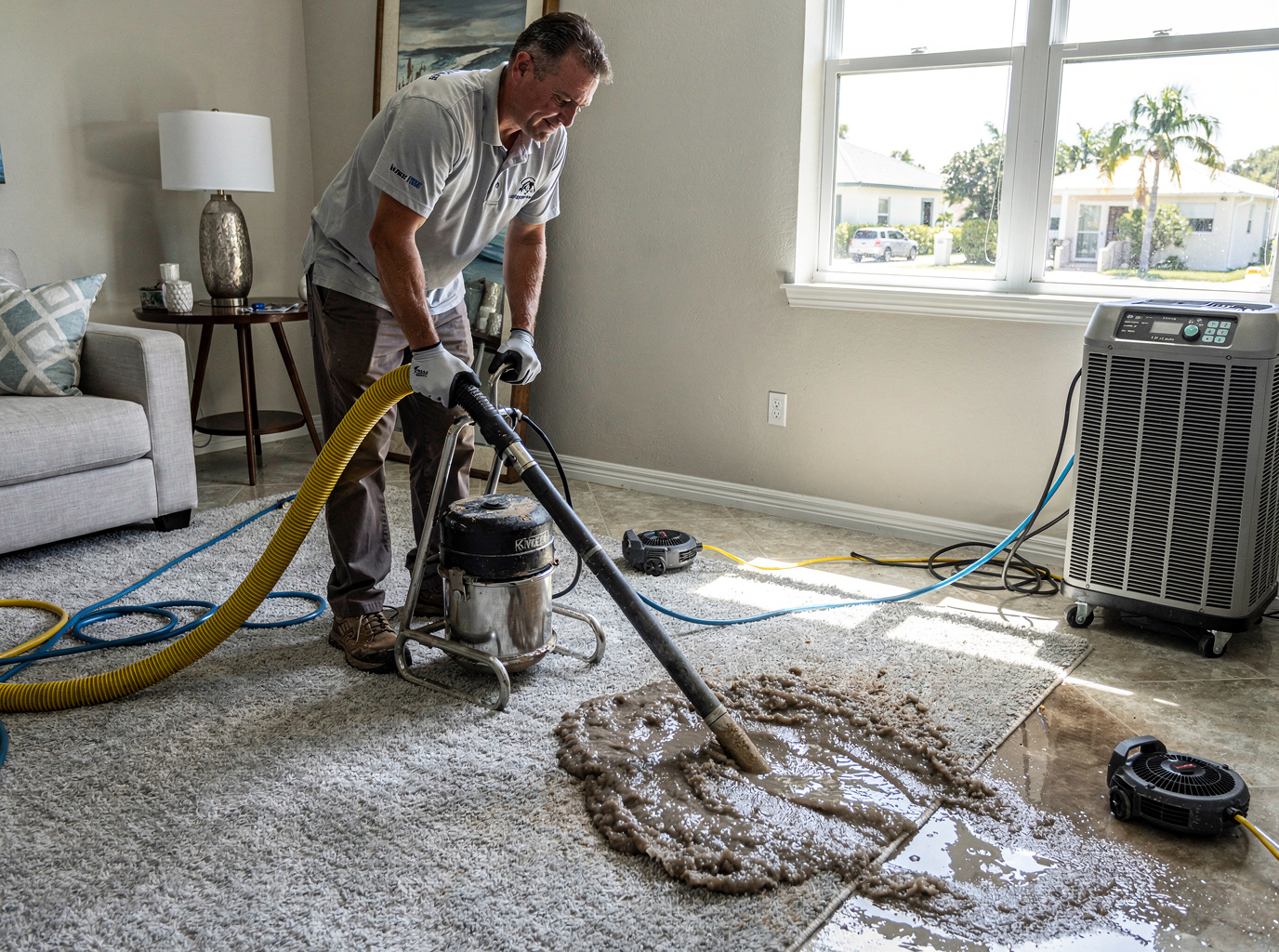
St. Petersburg's older housing stock in neighborhoods like Old Northeast and Kenwood often features plaster walls and raised wooden floors over crawl spaces that trap moisture after heavy rains or appliance leaks. Once water enters these cavities it spreads quickly through the humid air common along Tampa Bay, raising the risk of hidden mold within 48 hours. Technicians must pull baseboards and use moisture meters on multiple layers because surface readings alone miss saturation in the subfloor.
Hurricane season brings storm surge and wind-driven rain that can overwhelm older roof flashings and window seals in downtown and Snell Isle properties. Extraction starts with pumps rated for standing water up to several inches, followed by industrial dehumidifiers that must run longer here than in drier climates to reach the 40-50 percent relative humidity target. Failure to address the elevated groundwater table near the bayfront leaves residual dampness that later damages new flooring or cabinetry.
Water damage repair in St. Petersburg also requires coordination with Pinellas County permitting when structural elements are affected. Crews document every step for insurance adjusters because claims frequently involve both primary water intrusion and secondary issues such as warped hardwood in historic homes. Proper disposal of saturated drywall and insulation follows local landfill rules that differ from those in neighboring counties.
Technician insight
In St. Petersburg the thing that catches most people out with Water Damage Restoration Service is how quickly moisture travels through the raised wooden floors and plaster walls of 1950s and 1960s homes once it hits the crawl space. The constant humidity off Tampa Bay keeps those cavities damp long after the visible water is gone, so we always pull more baseboard than homeowners expect.
Crawl Space Saturation After Summer Storm
Heavy afternoon rain overwhelmed a downspout in a Kenwood bungalow and water entered the crawl space. We found saturated insulation and mold starting on floor joists. Extraction and targeted drying prevented spread into the living area, and the homeowner avoided full floor replacement.
Water Damage Restoration Service Services We Offer
✓Emergency Water Extraction
Rapid removal of standing water from floors and carpets using truck-mounted pumps to prevent further saturation in St. Petersburg crawl spaces.
✓Structural Drying and Dehumidification
Placement of commercial air movers and dehumidifiers calibrated for Florida humidity levels to dry wall cavities and subfloors without promoting mold.
✓Mold Remediation After Water Damage
Containment and removal of mold growth triggered by prolonged moisture in older plaster and lath construction common throughout Old Northeast.
✓Carpet and Pad Replacement
Removal and disposal of water-soaked carpet and padding followed by installation of new materials suited to high-humidity coastal homes.
✓Drywall Repair and Restoration
Cutting out saturated drywall, treating studs, and reinstalling new board with moisture-resistant products for Pinellas County code compliance.
✓Content Cleaning and Pack-Out
Documentation, removal, and cleaning of salvageable furnishings and belongings from affected rooms before restoration begins.
Water Damage Restoration Service Cost in St. Petersburg, FL
| Service | Typical Range | What Affects It |
|---|---|---|
| Emergency Water Extraction | $250–$650 | Varies with depth of standing water and number of rooms. |
| Full Structural Drying | $800–$2,200 | Influenced by home age, insulation type, and daily equipment needs. |
| Mold Remediation Add-On | $1,200–$3,500 | Depends on square footage and containment requirements in older homes. |
| Drywall Removal And Replacement | $400–$1,100 | Based on linear feet of wall and finish level. |
Ranges are typical for St. Petersburg, FL and confirmed with an exact written quote before any work starts.
How it works
- 1
On-Site Assessment
Technicians inspect all affected rooms, use moisture meters on walls and floors, and document damage for insurance purposes.
- 2
Water Removal
Standing water is extracted with pumps and wands, then debris is cleared to allow drying equipment access.
- 3
Drying And Monitoring
Air movers and dehumidifiers run until moisture readings reach safe levels, with daily checks to adjust equipment placement.
- 4
Repairs And Restoration
Damaged materials are replaced, surfaces are treated, and the space is returned to pre-loss condition.
Pricing
Cost depends on water category, affected square footage, and drying duration required by local humidity.